
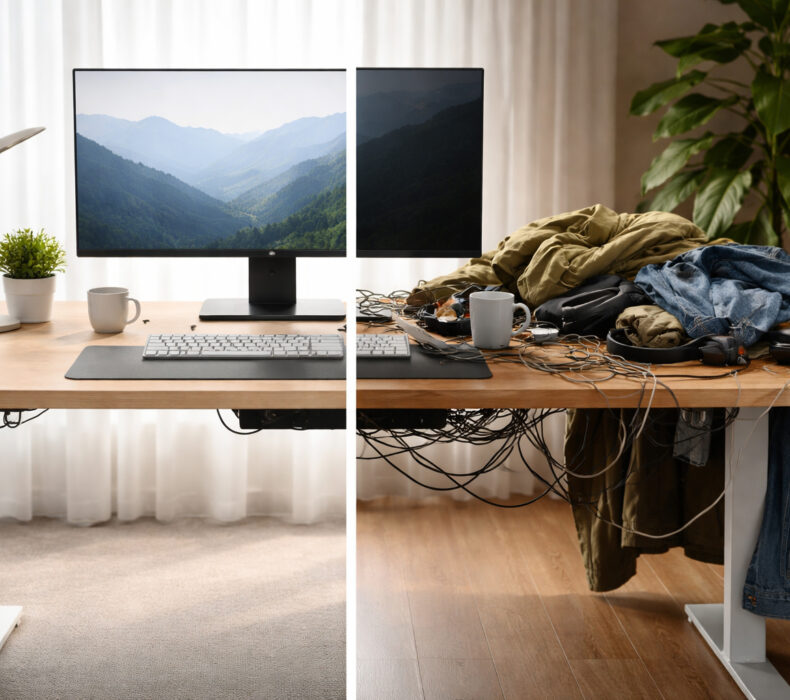
Are standing desks worth it? After 30 years of sitting at a desk for a living, I have a very specific answer – and it’s not the one most review sites will give you.
I’ve been sitting at a desk for 30 years. Not occasionally. Not part-time. Eight to ten hours a day, five days a week, designing for clients who needed everything yesterday and paying me like tomorrow would never come.
My back has opinions about this. Loud ones.
So when standing desks exploded into the mainstream, I paid attention. I read the studies. I watched the Reddit threads. I talked to people who bought them. And I noticed something nobody in the “standing desk benefits” articles ever mentions:
A remarkable number of them end up as very expensive places to hang jackets.
Here’s the honest breakdown – because most review sites are trying to sell you one.
QUICK ANSWER
A standing desk is worth it if and only if you’ll actually use it as a sit-stand desk – meaning you switch positions multiple times a day, every day, for months. If that sounds like you, yes, absolutely. If that sounds optimistic, you’re about to spend $400-700 on a very sturdy shelf.
The science is clear: the benefits are real but modest, and they require consistent use. The coat rack problem is also real – studies suggest a significant portion of standing desk owners revert to sitting full-time within weeks.
→ See FlexiSpot E7 pricing – our top pick for people who’ll actually use it
A standing desk doesn’t fix bad habits. It exposes them.
10-SECOND DECISION
Buy it if: You sit 7+ hours daily, have documented back/neck discomfort, work from home, and are ready to build a sit-stand routine Wait if: You’re hoping it’ll fix back pain that hasn’t been assessed by anyone Skip it if: You already move regularly, or you know yourself well enough to know you won’t change the height
What You Actually Get (And What You Don’t)
The benefits of standing desks are real. They’re just not magic.
The research shows: people who use sit-stand desks properly report 32-54% reduction in upper back and neck pain after several weeks. Energy levels improve. The afternoon slump gets less brutal. Blood sugar management improves slightly after meals.
That’s genuinely good.
What the research also shows, and what the desk companies prefer not to highlight: standing all day is not better than sitting all day. You’ve traded one static posture for another. The goal was never to stand – it was to move. Alternating between sitting and standing every 30-60 minutes is where the benefit lives. Not in standing.
Also worth knowing: standing burns approximately 8 more calories per hour than sitting. Over a 6-hour workday, that’s 48 extra calories. One small apple. If anyone sold you a $600 desk as a weight loss tool, you’ve been had.
The real benefit is interrupting prolonged sitting – and you can do that with a $0 phone alarm and a commitment to stand up every hour. The desk just makes it easier to keep working while you do it.
Why It Ends Up as a Coat Rack
There’s a predictable pattern documented extensively on Reddit’s r/StandingDesk and r/productivity communities: person buys desk, uses it enthusiastically for 2-4 weeks, gradually sits more, eventually forgets to raise it, desk becomes storage surface or jacket holder.
Why does this happen?
The purchase feels like the solution. The moment you buy a standing desk, your brain registers “back pain problem: solved.” The behavioral change – actually adjusting the desk multiple times a day, building the habit – never gets the same neurological reward. You feel better before you’ve done anything.
Standing is mildly uncomfortable at first. Your feet hurt. Your legs get tired. This is normal and passes within 2-3 weeks for most people. But most people don’t have 2-3 weeks of motivation built up from a purchase they made 3 weeks ago.
There’s no feedback loop. The desk won’t remind you. It just stays down.
As a designer who spent three decades glued to a monitor, I understand this problem specifically. Creative and deep focus work has a pull to it – you get into a flow state and the last thing you want is to break it to press a button and wait 15 seconds for your desk to rise. The habit has to be stronger than the inertia of flow.
The Real Price Tag
Here’s what it actually costs:
| Item | Cost range |
|---|---|
| Decent electric standing desk (dual motor) | $400-700 |
| Anti-fatigue mat (non-negotiable if you stand) | $60-120 |
| Monitor arm (your monitor height needs to adjust too) | $40-100 |
| Cable management (optional but you’ll want it) | $20-50 |
| Total realistic cost | $520-970 |
Cheap desks wobble, struggle with weight, and make you stop using them. Mid-range ($400-600) is where the value starts to make sense – dual motors, stable frame, memory presets that make switching positions frictionless.
If you don’t use it, even a better chair would’ve helped more.
Are Standing Desks Worth It for You? Here’s When Yes
You work from home 6+ hours a day at a dedicated desk. This is the primary use case. The desk pays off over months and years of daily use. The math changes completely for hybrid workers who spend 3 days in an office with a different setup.
You have confirmed back or neck issues related to sitting posture. Key word: confirmed. Meaning someone who knows about spines looked at you and said “your problem is posture and prolonged sitting.” Not self-diagnosed from a Reddit thread.
You’re already a person who builds and maintains habits. If you track workouts, stick to sleep schedules, or have successfully changed other behaviors – you’ll use the desk. If your gym membership is gathering dust, pattern recognition suggests the desk might too.
You have a setup that makes it frictionless. Monitor arm so the screen adjusts with the desk. Anti-fatigue mat already on the floor. A reminder system. A specific sit-stand schedule to start. Without these, the desk is furniture.
When It’s a Waste of Money
You already move during the day. If you take regular walks, have meetings that get you up, or work in a space where you’re not desk-bound for 6+ continuous hours, the standing desk solves a problem you don’t really have.
You’re hoping it fixes back pain. A standing desk is not a medical device. Chronic back pain has causes. Some of those causes are helped by reducing sitting time. Some aren’t. If your back hurts, see someone who knows backs before spending $600 on furniture.
You know yourself. This is the honest one. Some people read this far and already know they won’t build the habit. That self-knowledge is worth more than any product review.
You’re buying the cheapest option. A single-motor desk that wobbles, has one height preset, and tops out at a low weight limit may cost you less money but will actively discourage you from using it. The friction of a bad desk trains you to leave it at sitting height.
If you’re building a smarter workspace overall, check our breakdown of the productivity tools actually worth paying for.
Skip This If You Are…
- A person who already walks or moves regularly throughout the day
- Someone whose back pain hasn’t been assessed by a professional
- A hybrid worker without a dedicated home workspace
- Anyone who’s watched their gym membership go unused
- Someone buying the cheapest electric desk available
Alternatives Worth Considering
| Option | Cost | Best for |
|---|---|---|
| Standing desk converter | $80-200 | Testing the concept before committing |
| Ergonomic chair upgrade | $200-600 | If you’re going to sit anyway, sit better |
| Scheduled movement breaks | $0 | If you have discipline and good shoes |
| Desk converter + mat | $120-280 | Apartment dwellers, people unsure about desks |
The converter option deserves more credit than it gets. For $100-150, you can test whether you’ll actually use a sit-stand setup before spending $600 on a full desk. Most people skip this step – and end up with coat racks.
FAQ
How long before I feel the benefits? Most research shows 2-4 weeks of consistent use before back and neck pain improvements become noticeable. The key word is consistent. Two days on, two weeks off doesn’t count.
How often should I switch between sitting and standing? The most-cited recommendation is every 30-60 minutes. Some research suggests aiming for 20% of your workday standing is sufficient. Start with 15-minute standing intervals and build from there – your feet will let you know.
Is a cheap standing desk worth it? Generally no. Under $300, you’re getting single motors, instability at standing height, and lower weight limits. The friction of a bad desk is a real barrier to use. Mid-range ($400-600) is where the value starts to make sense.
Can a standing desk fix my back pain? It can help reduce back pain caused by prolonged sitting with poor posture. It cannot fix structural issues, disc problems, or pain from other causes. See a professional before assuming standing is your answer.
Do I need an anti-fatigue mat? Yes. Standing on a hard floor for extended periods is genuinely uncomfortable and will accelerate the desk-becoming-coat-rack timeline. The mat isn’t optional.
The Verdict
Standing desks work. The research is solid, the benefits are real, and for the right person in the right situation, it’s one of the better investments you can make in your daily health and comfort.
After 30 years of sitting for a living, I understand why people want a solution that requires minimal behavior change. A desk that rises at the push of a button sounds like exactly that.
But it isn’t. The desk doesn’t stand for you. It just makes standing easier when you decide to do it – and that decision has to happen dozens of times, every week, for months before it becomes automatic.
If you’ll do that work, something like the FlexiSpot E7 is a solid starting point – dual motors, stable frame, enough presets to make the habit frictionless. If you’re not sure, buy a converter first. Test yourself for a month. Then decide.
The coat rack joke is funnier when it’s not about your own $600 purchase.
→ Check FlexiSpot E7 current pricing → Or start with a desk converter if you want to test first
Most people don’t need a better desk. They need better habits.

Survived 20 years of clients, deadlines, and bad briefs. Started Wizformer to see if working for yourself is actually better. Jury's still out.