
Quick Answer
The Oura Ring vs WHOOP debate is one of the most common questions in wearable health tracking. If you sleep like a normal human and want to understand your body better – Oura Ring. If you train hard, obsess over recovery data, and don’t mind paying more every year – WHOOP. If you’re still deciding, keep reading.
The 10-Second Decision
Don’t want to read 2,000 words? Fine.
Get Oura if you care more about sleep, stress, and overall health. Get WHOOP if you train hard and want to optimize performance and recovery. If you hate subscriptions, you probably shouldn’t buy either.
That’s it. Everything below just explains why.
👉 Still unsure? Scroll to the comparison table – that’s where most people decide.
What Are These Things, Exactly?
Two screenless wearables that cost more than your last three pairs of sneakers combined – and then ask for a subscription on top of that. No display. No notifications. No step competitions with your coworker Karen.
What they offer instead: continuous tracking of your heart rate, heart rate variability (HRV), sleep stages, body temperature, and recovery data. All packaged into a daily score that tells you whether to hit the gym or go back to bed.
The idea is simple. The price is not.
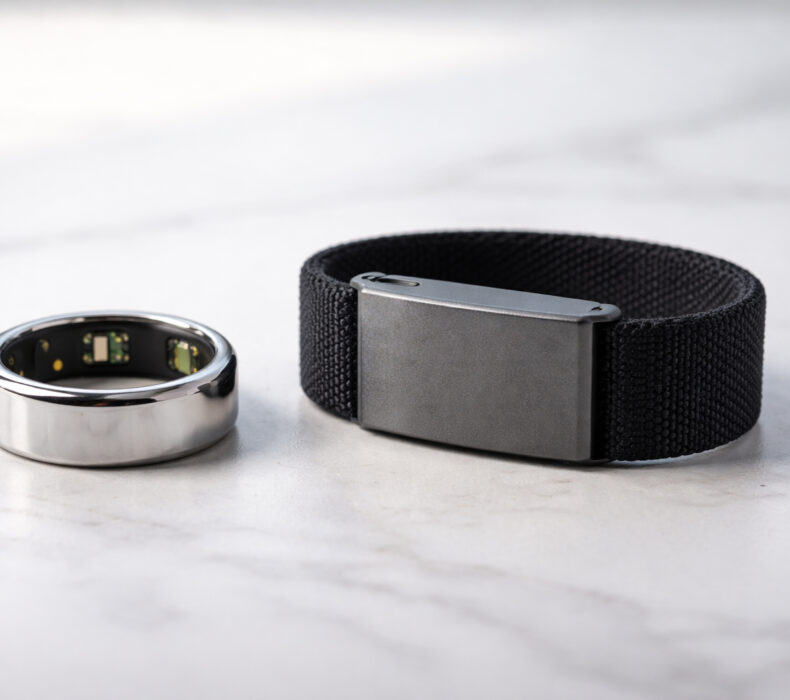
Oura Ring (latest generation) sits on your finger. Looks like jewelry. Starts around $299–$349 depending on the finish, plus $5.99/month for the full app experience.
WHOOP 4.0 wraps around your wrist. No screen, no upfront hardware cost – you pay a subscription (typically $199–$239 per year), and the device comes included.
Both claim to know your body better than you do. Let’s see who’s actually worth paying for.
The Comparison Table
| Oura Ring | WHOOP 4.0 | |
|---|---|---|
| Form factor | Ring (finger) | Band (wrist/body) |
| Upfront cost | $299–$349 | $0 (included in plan) |
| Subscription | ~$72/year ($5.99/mo) | $199–$239/year |
| 3-year total cost | ~$515 | ~$597–$717 |
| Battery life | 7 days | 4–5 days |
| Sleep tracking | ⭐⭐⭐⭐⭐ Excellent | ⭐⭐⭐⭐ Very good |
| Workout/strain tracking | ⭐⭐⭐ Decent | ⭐⭐⭐⭐⭐ Best in class |
| HRV accuracy | ⭐⭐⭐⭐⭐ Strong | ⭐⭐⭐⭐ Strong |
| Design/discretion | ⭐⭐⭐⭐⭐ Invisible | ⭐⭐⭐ Noticeable |
| ECG / blood pressure | ❌ | ❌ |
| Free trial | ❌ | ✅ 30 days |
Round 1: Sleep Tracking
This is where Oura has a consistent edge – and the reason is mostly anatomy.
Multiple independent validation studies have shown strong agreement between Oura’s overnight measurements and medical-grade reference devices, particularly for resting heart rate and HRV during sleep. The finger simply provides cleaner data than the wrist: blood vessels there sit closer to the surface, are less affected by movement, and give sensors a stronger, more stable signal.
WHOOP is also solid at sleep tracking. No complaints there. But most independent reviews and head-to-head comparisons place Oura slightly ahead in sleep staging accuracy – particularly for deep sleep and REM detection.
One practical difference: Oura has your sleep data ready the moment you open the app. WHOOP can sometimes take longer to process overnight data before it’s available. Small detail, but if checking your sleep score is part of your morning routine, it adds up.
Oura also has a temperature deviation feature that can sometimes indicate changes in your body before you feel symptoms. Multiple users report noticing their temperature trend shift before a cold hit. That’s a genuinely useful early warning signal.
Winner: Oura Ring (slight but consistent edge in sleep)
Round 2: Training & Recovery
WHOOP was built by athletes, for athletes. Its strain scoring system – a 0–21 scale for daily cardiovascular load – is one of the most widely used recovery systems in the consumer wearable space.
The logic works like this: WHOOP quantifies how hard you pushed your body, compares it to your rolling 30-day personal baseline, and gives you a recovery color. Green means push hard. Yellow means moderate. Red means go home.
The key word there is personal baseline. Your recovery score reflects your norms, not population averages. Because what counts as strong HRV for one person is completely different from another, this matters more than most wearable brands admit.
WHOOP also has a Journal feature that lets you log habits – alcohol, supplements, sleep timing, specific stressors – and over time, it generates correlations between those behaviors and your actual recovery data. That’s genuinely useful feedback. Not “drink less alcohol, it’s bad.” More like: “every time you have two drinks, your HRV drops the next morning.” Numbers are harder to argue with than advice.
Oura has a Readiness Score that serves a similar purpose, but it’s more general – better suited for overall wellness than serious athletic optimization.
One real-world WHOOP limitation worth noting: it focuses on cardiovascular strain and recovery, but doesn’t replace detailed strength tracking. Reps, sets, progressive overload – that’s not what it does.
And here’s an Oura Ring problem nobody mentions until after they’ve bought one: you cannot comfortably lift weights with a ring on. Barbells, dumbbells, pull-up bars – they scratch a $300+ titanium ring fast. Many weightlifters remove it during training entirely, which means gaps in data during the sessions that matter most.
WHOOP can be worn on the wrist, bicep, or embedded in specialized athletic apparel during heavy lifting or contact sports. That flexibility is a real advantage.
Winner: WHOOP (built for performance, recovers like a drill sergeant)
Round 3: The Subscription Trap Nobody Talks About
Let’s do the math the marketing materials hope you won’t.
Oura Ring (starting at $299): Year 1: $299 + $71.88 = ~$371 Year 2–3: $71.88/year 3-year total: ~$515
WHOOP 4.0 (standard plan ~$199/year): Year 1–3: $199/year 3-year total: $597
WHOOP higher plan ($239/year): 3-year total: $717
Oura’s “expensive upfront” framing evaporates pretty quickly once you do the math. The subscription gap is significant.
WHOOP’s subscription model has occasionally sparked criticism from users – particularly around pricing changes and hardware upgrade expectations. The core model is simple: you pay for continuous platform access, hardware included. But the fine print on plan transitions deserves careful reading before you commit.
Winner: Oura Ring (meaningfully cheaper over 3 years)
Round 4: Design & Real-World Wearability
The Oura Ring is the more elegant device. Full stop. It looks like jewelry – available in silver, gold, black, stealth, and rose gold finishes – and weighs between 4 and 6 grams. You genuinely forget it’s there. You can wear it to a job interview, a first date, or a funeral and nobody will know it’s tracking your HRV.
WHOOP is a rubber strap without a screen. It does what it does. It’s fine at the gym. It’s a little less fine when you’re trying to look like a functional adult at a dinner meeting.
On battery life: Oura lasts longer per charge (7 days vs 4–5), but WHOOP is more flexible because you can charge it without taking it off, using a clip-on battery pack. On a long trip where you forget your charger, WHOOP keeps running. Oura does not.
There have been occasional user reports of skin irritation or discomfort with continuous wear on both devices. These appear to be isolated cases rather than widespread issues, but if you have sensitive skin, it’s worth noting.
Winner: Tie (design: Oura, charging flexibility: WHOOP)
What Most People Get Wrong
Most people treat this as a tech specs battle. It’s not.
Choosing the right tool is a pattern we see everywhere – whether it’s picking the best AI writing tools or the best wearable for your lifestyle. The question isn’t “which device is more accurate.” Both are accurate enough to be genuinely useful. The question is: what are you actually going to use it for?
If you train seriously and want to optimize training load and recovery – WHOOP is built for exactly that.
If you work a stressful job, sleep inconsistently, and want to understand what’s happening to your body at night – Oura is the clearer answer.
If you want both? You’ll find many users online who run Oura for sleep and WHOOP for training simultaneously. At that point your wearable budget exceeds your grocery budget and you should probably talk to someone.
The Verdict
Choose Oura Ring if:
- Sleep quality and general wellness are your main focus
- You want the lowest long-term subscription cost
- You work in environments where a wristband looks unprofessional
- You don’t train at high intensity regularly
👉 Try Oura Ring – starting at ~$299 + $5.99/month
Choose WHOOP if:
- You train seriously and want strain-based performance data
- You want to try before you commit (30-day free trial available)
- You prefer no upfront hardware cost
👉 Try WHOOP 4.0 – from $199/year, 30-day free trial available
FAQ
Do I need a subscription for both? Yes. Both devices require a subscription to access full data. Oura’s is significantly cheaper at about $72/year vs WHOOP’s $199–$239/year.
Which is more accurate for sleep tracking? Oura has a consistent edge based on multiple independent validation studies, primarily due to the finger’s superior signal quality compared to the wrist.
Can I wear the Oura Ring while lifting weights? Technically yes, but most weightlifters remove it. Barbells and dumbbells scratch titanium fast – and you’re paying too much for that ring to treat it like gym equipment.
Does WHOOP track steps? Step tracking is limited and not a core feature compared to other wearables. If step counting is a priority, factor that in before buying.
Which one is better for non-athletes? Oura Ring, without hesitation. Its data presentation is more intuitive, its focus is broader wellness rather than athletic performance, and it costs significantly less over time.
Is there a cheaper alternative to both? Yes – the Samsung Galaxy Ring is a newer alternative with no mandatory subscription, but long-term accuracy and validation are still being evaluated. Worth considering for casual wellness tracking.

Survived 20 years of clients, deadlines, and bad briefs. Started Wizformer to see if working for yourself is actually better. Jury's still out.