
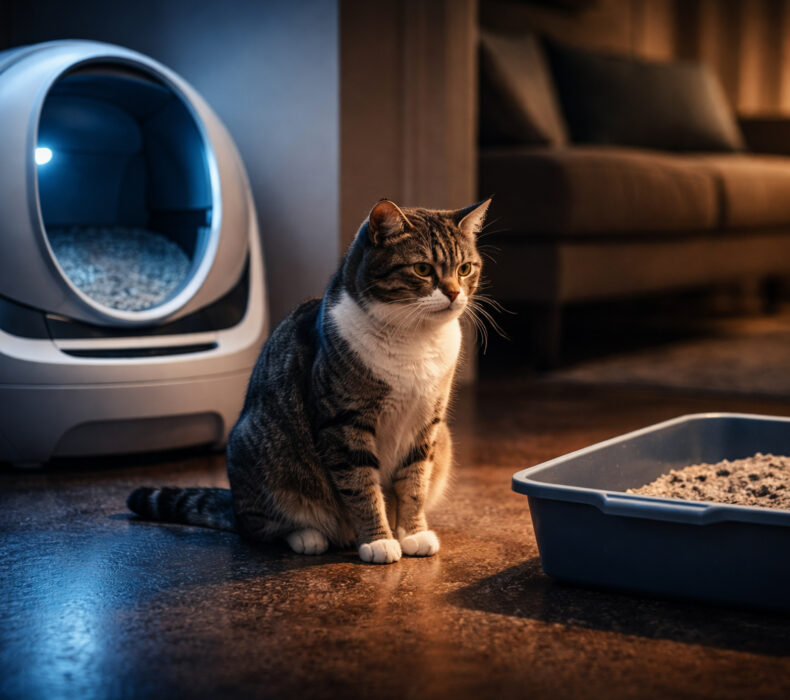
You know that feeling when you buy something expensive, bring it home, and watch your cat walk past it like it doesn’t exist? Welcome to the self-cleaning litter box experience – for the wrong cat, exactly that. For the right household, genuinely life-changing.
So, are self-cleaning litter boxes worth it – or is this just an expensive mistake? The honest answer depends entirely on your cat and your household. Not on the specs.
I don’t have a cat. What I do have is little kids, a full-time job, a wife with her own business, and a deep personal understanding of having zero free time. When cat owners say that daily scooping finally broke them – I believe it completely. Some people have a dishwasher not because they’re lazy but because they’d rather spend those 20 minutes on literally anything else. Same logic applies here.
Quick Answer (TL;DR)
- YES – 2+ cats, busy household, relaxed cats
- MAYBE – single cat, moderate budget, easygoing cat
- NO – anxious, senior, or opinionated cat
If you’re already in the “buy it” category, check the current Litter-Robot 4 price here ->
Who Actually Buys These Things
The self-cleaning litter box market isn’t a niche corner of the internet anymore. There are an estimated 49 million cat-owning households in the US, and Litter-Robot alone has sold over 1.5 million units. These are not early adopters. These are regular people with an understandable aversion to daily scooping.
The math that usually pushes people over the edge: the average cat owner spends 5-10 minutes per day on litter maintenance. That’s 60+ hours per year. One couple calculated they’d spent 390 hours scooping over 13 years with two cats – more than two and a half weeks of their lives, one scoop at a time. At that point, $700 starts looking less like a luxury and more like a business decision.
The Problem Nobody Warns You About
Here’s what every review buries in paragraph eight: your cat gets a vote.
Cats are creatures of habit with sensitive hearing and strong opinions about enclosed spaces, unexpected noises, and anything that smells wrong. Self-cleaning litter boxes have motors, sensors, and rotating mechanisms that activate automatically – sometimes while the cat is still nearby. For some cats, this is fine. For others, it triggers an immediate and permanent boycott.
The ASPCA explicitly warns that if your cat starts eliminating outside the box after you introduce a self-cleaning model, you should switch back to a traditional one. PetSafe has an entire guide on helping cats overcome their fear of automatic litter boxes. That guide exists because the fear is common enough to warrant it.
Cats most likely to reject self-cleaning boxes: anxious or easily startled cats, seniors who may struggle with higher entry points, kittens under 3 pounds who are too light to trigger safety sensors, and cats with strong litter preferences that conflict with what the machine requires.
10-Second Decision Guide
- Multi-cat household, busy schedule, relaxed cats – buy it
- Single cat, medium budget, easygoing cat – start with a $300 option first
- Anxious, elderly, or opinionated cat – skip it, your floor will pay the price
- You want to monitor your cat’s health remotely – yes, the app data is genuinely useful
- Thinking of buying cheap to “test the concept” – don’t, budget models under $200 are mostly junk
If you’re also comparing smart pet tech for dogs, we broke down the best GPS dog trackers here, and the best human-grade dog food options here.
Best Self-Cleaning Litter Boxes at a Glance
- Best overall: Litter-Robot 4 (most reliable)
- Best value: PetKit PuraMax 2 (cheaper alternative)
- Best budget: MeoWant SC02 (entry-level)
The Products Worth Talking About
Litter-Robot 4 by Whisker – $699
The benchmark everything else gets measured against. A rotating globe sifts waste after each use and deposits it into a sealed, carbon-filtered drawer. The Whisker app tracks your cat’s weight and visit frequency – which turns out to be genuinely useful for catching health issues early, since unusual urination patterns are often the first sign of kidney or urinary problems.
Pros: extremely quiet at 45 dB (soft conversation level), well-built, excellent odor control, 90-day money-back guarantee. Cons: $699 upfront, optional OdorTrap packs at $15 every two weeks push annual costs higher, and the standard one-year warranty feels short for a $700 appliance with sensors and moving parts.
CNN Underscored, Cats.com, and multiple independent testers named it the top pick after hands-on testing. Over 50,000 user reviews hold at 4.7 out of 5. That kind of consensus is hard to fake.
Check Litter-Robot 4 Price (90-Day Risk-Free Trial) ->
Litter-Robot 5 – $799+
The newest model adds AI-powered waste analysis that distinguishes between liquid and solid waste, expanded multi-cat recognition, and a redesigned base for better performance on carpet. Worth the extra hundred if you have 3+ cats or a cat with a health condition you’re monitoring. For most households, the 4 is enough.
PetKit PuraMax 2 – $600
The main alternative that gets serious consideration. CNN Underscored tested both and found the PuraMax 2 delivers excellent cleaning results at a lower price. It’s quieter and more compact than the Litter-Robot – a real advantage in smaller apartments. The tradeoff: clumps occasionally stick to interior walls, requiring some manual intervention. Not a dealbreaker, but worth knowing.
See PetKit PuraMax 2 Price (Cheaper Alternative to Litter-Robot) ->
PetKit Pura X – ~$400
Reliable for single-cat households and a reasonable way to test whether you and your cat are even suited for automatic litter boxes before committing to $700. The 6L waste drawer needs emptying every 2-3 days with multiple cats, which partially defeats the low-maintenance premise.
MeoWant SC02 – ~$300
Compact, quiet at 38 dB, and affordable. App connectivity, safety sensors, decent odor control. It won’t match the Litter-Robot in build quality or longevity, but for a first-time buyer not ready to spend $700, it’s a legitimate starting point.
Check Budget Option: MeoWant SC02 (Under $400 Entry Model) ->
What Most People Get Wrong
The biggest mistake is buying cheap to “test the concept.” Automatic litter boxes under $200 – including some rotating-globe designs sold on Amazon under various brand names – have documented safety concerns, including reported sensor failures that can trap cats during cleaning cycles. Stick to established brands with verified, redundant safety systems.
The second mistake is expecting zero maintenance. Even the best self-cleaning litter box needs the waste drawer emptied roughly once a week per cat, monthly spot cleaning, and quarterly deep cleaning. The selling point isn’t “never think about it again” – it’s “never scoop again.” Those are different things.
The Real Cost Math
- Hardware: $699
- Extended 3-year warranty (recommended): $100
- Carbon filters (monthly): ~$60/year
- Total year one: ~$859
- Years 2-4: ~$60/year in filters
Whether $859 is worth 60+ hours of your time per year depends entirely on what your time is worth to you. If you have kids, a demanding job, and a household to run – the math probably works. If you live alone and don’t mind the routine – it probably doesn’t.
Verdict
Self-cleaning litter boxes are not a gimmick. The technology works, the best models are well-built, and for the right household they change daily quality of life in a way that’s hard to overstate.
Right household: 2+ cats, busy schedule, relaxed cats, willing to learn a new system. Wrong household: anxious cats, single cat on a tight budget, anyone expecting zero maintenance.
If you’re in the right household – the Litter-Robot 4 is the safest choice with the longest track record. If you want to test the concept without risking $700 – start with the MeoWant SC02.
Your cat will give you their verdict within the first week. Pay attention to it.
Check Litter-Robot 4 Price (90-Day Risk-Free Trial) -> See PetKit PuraMax 2 Price (Cheaper Alternative to Litter-Robot) -> Check Budget Option: MeoWant SC02 (Under $400 Entry Model) ->
Frequently Asked Questions
Will my cat actually use a self-cleaning litter box? Most cats adapt within a few days to a week, especially if you keep their old box nearby during the transition. Anxious, elderly, or very small cats are most likely to reject it. No self-cleaning box comes with a guarantee that your specific cat will approve.
Do self-cleaning litter boxes actually control odor? The better models – particularly the Litter-Robot 4 with its sealed, carbon-filtered waste drawer – significantly reduce odor compared to a traditional box sitting uncleaned for hours. Budget models with poor sealing perform much worse.
Are they safe for cats? Reputable brands like Litter-Robot and PetKit use multiple redundant safety sensors that stop the cleaning cycle if weight or motion is detected. Budget models from unknown sellers have documented safety concerns. Buy only from established brands with verified safety systems.
How often do you still need to clean them? Waste drawer emptying roughly once a week per cat, monthly spot cleaning, quarterly deep cleaning. You eliminate daily scooping – not all maintenance.
Is a self-cleaning litter box worth it for one cat? Depends on your budget and your cat’s personality. The convenience is real even with one cat – you still eliminate daily scooping and get health monitoring via the app. But the ROI math is stronger with multiple cats. For single-cat households on a budget, start with the MeoWant SC02 at ~$300 rather than jumping straight to $700.
Is the Litter-Robot 5 worth the extra $100 over the 4? For most households: no. Useful if you have 3+ cats or are monitoring health conditions. For everyone else, save the hundred dollars.

Survived 20 years of clients, deadlines, and bad briefs. Started Wizformer to see if working for yourself is actually better. Jury's still out.