
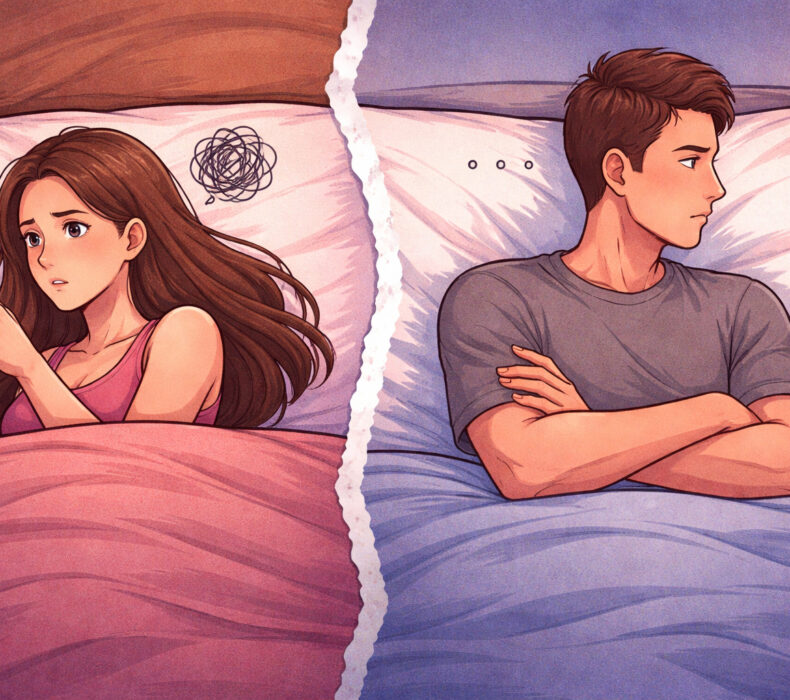
You’ve been here before. This is the story of why anxious and avoidant people always find each other.
Someone pulls away, you chase. Someone chases, you pull away. Or maybe it’s always been the same role – you’re always the one checking your phone, reading into silence, wondering what you did wrong. And somehow, every person you’ve dated has been the same kind of emotionally unavailable.
That’s not bad luck. That’s attachment theory playing out in real time.
John Bowlby spent decades studying how humans form emotional bonds. His conclusion – later expanded by Mary Ainsworth’s landmark Strange Situation research – was straightforward: the way you were loved as a child becomes the template for how you love as an adult. Not consciously. Not deliberately. Just automatically, the way your body breathes without you telling it to.
This piece is about one specific pattern that shows up in relationships more than almost any other: what happens when an anxiously attached person and an avoidantly attached person find each other. Which they always do.
Quick Answer
People with anxious attachment styles who crave closeness and fear abandonment and people with avoidant attachment styles who value independence and pull back from intimacy are magnetically drawn to each other – not despite their differences, but because of them. The anxious partner mistakes emotional distance for depth. The avoidant partner mistakes intensity for love. Both are replaying childhood wounds they don’t know they have. Understanding this pattern is the first step to changing it.
First: the four attachment styles
Attachment theory identifies four main styles. Three of them will be relevant to almost every relationship you’ve ever been in.
Secure – comfortable with intimacy and independence. Can ask for what they need. Trust that others will be there. Estimated around 50% of adults, though figures vary across studies.
Anxious – intense need for closeness, constant low-grade worry that the relationship is about to fall apart. Every unanswered text is a potential catastrophe. Every moment of distance feels like abandonment. About 20% of adults.
Avoidant – values independence to the point where intimacy feels threatening. Pulls back when things get too close. Describes past partners as too needy more often than average. About 25% of adults.
Disorganized (Fearful-Avoidant) – wants closeness and is terrified of it simultaneously. Often linked to early trauma. The most complex to navigate.
The anxious and avoidant pairing is the most common dynamic in therapy offices, relationship forums, and Reddit threads at 2am. Here is why.
Why Anxious and Avoidant People Always End Up Together
It is not random. There are three specific mechanisms at work.
Familiarity feels like chemistry
The brain is a pattern-matching machine. It recognizes familiar emotional dynamics not as warning signs, but as comfort. If you grew up with a caregiver who was loving but inconsistent – warm one day, unavailable the next – that inconsistency gets encoded as what love feels like.
So when an anxious person meets someone emotionally distant, something fires in their brain that says: this is familiar. Familiar gets misread as connection. The pursuit of intermittent affection from an avoidant partner feels exactly like the childhood experience of trying to earn love from an inconsistent parent.
The avoidant person has their own version of this. They often had caregivers who expected emotional self-sufficiency early. An anxious partner’s intensity feels familiar – uncomfortable, but familiar. They know how to handle it. They know how to create distance. It’s what they’ve always done.
The initial dynamic is actually perfect – for exactly six weeks
Here’s the part nobody talks about. At the beginning of an anxious avoidant relationship, both people’s attachment systems are temporarily satisfied.
The avoidant partner pursues heavily at the start. New relationships aren’t threatening yet. They haven’t gotten close enough to feel engulfed. So they show up fully – attentive, present, pursuing. This is exactly what the anxious partner has always wanted: someone who seems to want them completely.
Then proximity increases. The avoidant partner starts to feel the intimacy as a threat. They pull back – subtly at first. The anxious partner notices the shift and activates: more texts, more reassurance-seeking, more intensity.
And that’s when both attachment systems confirm what they’ve always believed. The anxious partner: see, people leave, I have to hold on harder. The avoidant partner: see, closeness suffocates me, I need space.
Both feel justified. Both are suffering.
Opposites fill in each other’s gaps – at first
An anxious person tends to be emotionally expressive, relationally focused, in touch with feelings. They find an avoidant partner’s calm steadiness reassuring. The avoidant doesn’t seem rattled by much. That feels like stability.
The avoidant finds the anxious partner’s warmth and expressiveness compelling. They feel things deeply in a way the avoidant has suppressed. It’s attractive – in small doses.
Each person believes the other has something they lack. The anxious partner thinks: if I can just get them to open up, everything will be fine. The avoidant thinks: if they could just be a little less intense, this would work perfectly.
Neither transformation arrives. The cycle continues.
What the cycle actually looks like
John Gottman’s longitudinal research on couples – tracking thousands of pairs over decades – identified the pursuer-distancer pattern as one of the strongest predictors of relationship breakdown. In anxious and avoidant dynamics, it runs like clockwork.
Phase 1 – Connection. Both feel the pull. Chemistry is real. The relationship begins with intensity.
Phase 2 – Closeness triggers avoidant withdrawal. As the relationship deepens, the avoidant partner begins to need more space. Less frequent contact. Nothing dramatic – just a slight pulling back.
Phase 3 – Anxious activation. The anxious partner senses the shift. Interprets distance as a sign the relationship is failing. Begins seeking reassurance – more messages, more checking in, wanting to talk about the relationship.
Phase 4 – Avoidant retreat. What feels to the anxious partner like reasonable reassurance-seeking feels to the avoidant partner like being smothered. They pull back further.
Phase 5 – Escalation. The more the anxious partner pursues, the more the avoidant retreats. The more the avoidant retreats, the more the anxious partner pursues. Neither is getting what they need. Both feel misunderstood.
Phase 6 – Brief reconnection. A fight, a crisis, or just the avoidant partner missing the connection causes them to reach back out. The anxious partner feels flooded with relief. The relationship resets – temporarily. Back to Phase 1.
This is why anxious and avoidant relationships often last a very long time. The cycle generates enough intermittent reinforcement – exactly the psychological mechanism behind slot machines – to keep both people invested. The reunions feel profound. The pattern reasserts itself within weeks.
The part nobody wants to hear
Secure people exist. An estimated 50% of adults carry a secure attachment style and are capable of a relationship that isn’t this exhausting. If you’ve ever wondered why smart people stay trapped in these dynamics, this goes deeper.
Anxiously attached people often describe secure partners as boring. There’s no chase. No will-they-won’t-they. No intensity. The nervous system – trained to expect inconsistency – interprets steady availability as a lack of passion.
Avoidant people often find secure partners too much – even when those partners are making entirely reasonable requests for connection.
Both attachment styles unconsciously filter out the very partners who would actually work for them.
This isn’t a character flaw. It’s a learned pattern. And learned patterns can be unlearned – but not by finding the right person. By understanding what you’re actually doing.
Can it actually work?
Yes. With significant caveats.
Both partners need awareness of the pattern – not just one. The anxious partner understanding their attachment style while the avoidant partner dismisses the concept entirely produces exactly zero change.
Sue Johnson’s Emotionally Focused Therapy (EFT) has the strongest research backing for anxious and avoidant couples specifically – published studies report success rates of around 70-75% for couples who complete the process. It addresses underlying emotional needs rather than just surface behaviors. Individual therapy – working through the childhood origins of each attachment style – is often more effective than couples work alone.
The most honest framing: an anxious and avoidant relationship can shift toward something secure. But it requires both people to do the work of building a more secure attachment style within themselves – not just changing their behavior with each other.
What to do if you recognize this pattern
If you’re the anxious partner: start by noticing the gap between what’s actually happening and what your attachment system is telling you is happening. A partner not texting back for two hours is not abandonment. Building a life and identity outside the relationship reduces the amount of reassurance-seeking the relationship has to carry.
If you’re the avoidant partner: your withdrawal isn’t neutral. To your partner, your silence communicates rejection even when you mean nothing by it. Proactive reassurance – reaching out before they ask, naming that you need space rather than just disappearing – dramatically reduces the anxious partner’s activation.
If you’re stuck in this cycle and nothing changes no matter how much you talk about it – that’s not a communication problem. That’s an attachment pattern that predates the relationship. This is exactly what therapy is designed for. Before you decide, read this honest breakdown of what online therapy actually costs and whether it works.
→ Online-Therapy.com connects you with licensed therapists who specialize in attachment and relationships. Sessions start at a fraction of traditional therapy costs.
Comparison Table
| Situation | Anxious Response | Avoidant Response |
|---|---|---|
| Partner doesn’t text back for 3 hours | Catastrophizing, drafting and deleting messages | Doesn’t notice, relieved by the space |
| Planning for the future | Wants clarity and commitment | Gets vague, changes subject |
| After a fight | Wants to resolve immediately, can’t sleep | Needs space before talking, shuts down |
| Partner says “I need some time alone” | Interprets as rejection | Feels like a reasonable and normal request |
| Early relationship | Intense, fully invested, already planning | Pursuing, present – until proximity increases |
FAQ
What causes anxious attachment? Typically, inconsistent caregiving in early childhood – a parent who was sometimes warm and available, sometimes not. The child learns that love is unpredictable and must be constantly pursued to be maintained.
What causes avoidant attachment? Usually, caregivers who were emotionally unavailable or who consistently dismissed emotional needs. The child learns that needing others leads to disappointment, so self-sufficiency becomes the survival strategy.
Can your attachment style change? Yes. Research suggests attachment styles are not fixed. Therapy – particularly attachment-focused work – can help significantly. So can a consistently secure relationship, if the person with the insecure style can tolerate it long enough.
How do I know which attachment style I have? The most reliable self-assessment is the Experiences in Close Relationships scale (ECR), developed by Brennan, Clark, and Shaver. There are validated online versions. Avoid the pop-psychology quizzes that reduce everything to four bullet points.
Is it possible for two avoidants to be together? Yes, and it tends to be lower conflict but also lower intimacy. Both partners maintain emotional distance which can result in a relationship that functions but feels emotionally flat.
Why does breaking up with an avoidant feel so hard? The intermittent reinforcement – good periods followed by withdrawal, followed by reconnection – creates a pattern similar to behavioral addiction. The brain anticipates the next reward and holds on through the difficult periods.
Verdict
The anxious and avoidant dynamic is one of the most studied patterns in relationship psychology – and one of the most common reasons people spend years in relationships that leave them feeling more alone than when they were single.
Understanding it doesn’t fix it. But it’s impossible to break a pattern you haven’t named.
If you recognize yourself in this article – whether as the pursuer or the distancer – the most useful thing you can do is not to find a better partner. It’s to understand why you keep finding the same one.
Note: This article discusses psychological patterns for informational purposes only and is not a substitute for professional mental health support. References: Bowlby (1969) Attachment and Loss; Ainsworth et al. (1978) Patterns of Attachment; Gottman and Levenson longitudinal couples research; Johnson (2004) The Practice of Emotionally Focused Couples Therapy. For accessible reading: Attached by Amir Levine and Rachel Heller.
Who this is NOT for
Just to be clear before you go diagnosing your entire relationship history:
- People looking for permission to stay in something genuinely harmful – the pattern explains behavior, it does not excuse it
- Anyone expecting a quick fix – decades of attachment patterns do not shift in a weekend
- People who want to use this as ammunition against their partner – this framework works best turned inward
- Those in acute crisis – a blog post is not a substitute for immediate professional support

Survived 20 years of clients, deadlines, and bad briefs. Started Wizformer to see if working for yourself is actually better. Jury's still out.