
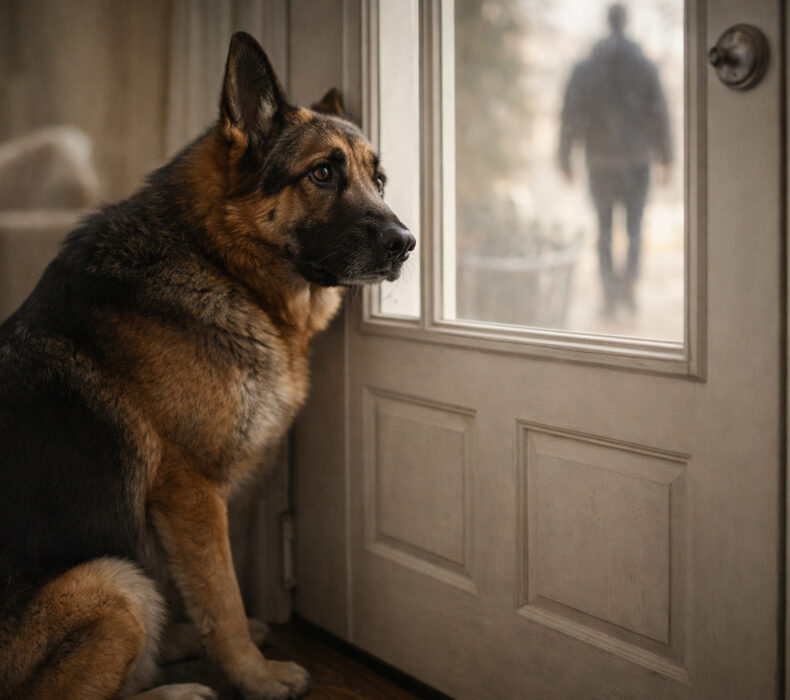
My German Shepherd didn’t have dog separation anxiety. He had a complete emotional breakdown every time I walked out the door. Barking, pacing, scratching at the door frame – the full show. Every single time.
I tried everything. Some things worked. A lot of things didn’t. And some of the most confidently marketed products were basically expensive placebo for dogs.
Here’s what I actually found – backed by research, real testing, and a very dramatic shepherd who eventually learned to chill.
Quick Answer: Dog separation anxiety is best treated with systematic desensitization – a behavior modification technique where you gradually teach your dog to tolerate being alone, starting with seconds and building up over weeks. Calming treats, cameras, and puzzle toys help manage symptoms but won’t fix the root problem on their own. Medication exists for severe cases and works best combined with training – not as a standalone solution.
What Dog Separation Anxiety Actually Is (Not What You Think)
Here’s what most people get wrong: separation anxiety isn’t your dog being dramatic or punishing you for leaving. It’s a genuine panic response – the canine equivalent of an anxiety attack.
Estimates of how many dogs are affected vary widely depending on how strictly the condition is defined – typically somewhere between 10% and 30% of dogs show meaningful separation-related behaviors, according to various studies. Whatever the exact number, it’s a lot of dogs. And a lot of destroyed door frames.
The behaviors that actually indicate separation anxiety – as opposed to boredom or normal dog stuff – are specific:
- Destructive behavior exclusively when you’re gone, not when you’re home
- Barking or howling that starts within minutes of your departure
- Attempts to escape near doors and windows
- House soiling from a dog that’s otherwise housebroken
- Excessive drooling or panting right before you leave
The key word is exclusively. A dog that chews your shoes while you’re sitting on the couch is bored. A dog that demolishes the door frame only when you leave has a real problem.
Why Your Dog Panics
Dogs read your routine like a book. Not just the obvious stuff – everything.
Putting on shoes. Picking up keys. Grabbing a jacket. By the time you reach the door, your dog has been tracking your leaving ritual for 15 minutes and is already in a stress response before you touch the handle.
This is why training has to start at the keys, not at the door.
Some dogs are more prone than others. Rescue dogs and dogs with unstable early histories show higher rates. Dogs that spent pandemic lockdowns glued to their owners – then suddenly got left alone 8 hours a day when offices reopened – were hit especially hard. That’s a pattern vets and trainers reported consistently enough to mention, not a proven scientific conclusion.
What Most People Get Wrong
“He’s doing it out of spite.” No. Dogs don’t do spite. What looks like revenge is panic. Treating anxiety as defiance leads to punishment, which makes anxiety worse. Every time.
“Just ignore it and he’ll figure it out.” For very mild cases, some dogs do habituate. For true separation anxiety, repeatedly putting your dog through a stress spiral without intervention doesn’t teach him it’s fine – it just means he panics more efficiently.
“More exercise will fix it.” Exercise helps. A tired dog is a calmer dog. But physical exhaustion doesn’t address a panic response. It’s like telling someone with a fear of flying to just go to the gym more.
“Crating will contain the damage.” Crating an anxious dog doesn’t make him less anxious. It just means the destruction happens inside the crate. Many dogs injure themselves trying to break out – broken teeth, torn nails, cut paws. A crate is not a treatment plan. It’s a box.
What Actually Works
If you skip desensitization for dog separation anxiety, nothing else on this list will matter. That’s not an opinion – it’s what the research consistently shows. Everything below supports the process. Nothing replaces it.
Systematic Desensitization – The Only Real Fix
This is the part nobody wants to hear because you can’t buy it.
Systematic desensitization has consistent scientific backing as the primary treatment for separation anxiety in dogs. It’s not glamorous. There’s nothing to purchase. And it requires daily effort over weeks or months. That’s probably why it’s the least popular option despite being the most effective.
The concept: teach your dog that short absences aren’t a big deal by starting with absences so short they don’t trigger anxiety – then gradually increasing.
The process:
- Walk to the door, touch the handle, come back. No drama, no emotional goodbye.
- Step outside for 5 seconds. Come back. Calm.
- Gradually increase over days and weeks.
- Never push past the point where anxiety starts. If he panics, you went too far too fast.
Research on this approach is consistent – significant reductions in both frequency and severity of separation behaviors, with improvements maintained months after treatment ended. And here’s the part worth noting: success wasn’t strongly tied to how perfectly owners followed the protocol. Dogs improved even when owners were inconsistent. You just have to actually do it.
Counterconditioning pairs naturally with desensitization. Pick up your keys. Give your dog something he loves. Put the keys down. Repeat until he hears keys jingling and thinks “snack time” instead of “the world is ending.”
Puzzle Toys and Kong Feeders – Genuinely Useful Support
A frozen Kong stuffed with peanut butter or wet food given just before you leave does two things: it creates a positive association with your departure, and it keeps your dog occupied during the first critical minutes – when anxiety peaks.
Lick mats work on the same principle. Licking triggers endorphin release in dogs – it’s a self-soothing behavior with some actual science behind it. A frozen lick mat can buy 20-30 minutes of calm for around $10-15.
The honest caveat: if your dog’s anxiety is severe, he may refuse food entirely. A dog in full panic mode doesn’t care about peanut butter.
Congratulations if you just bought a $40 puzzle toy your dog ignores while having a panic attack. You’re not alone – and once the desensitization work brings his baseline anxiety down, he’ll actually use it.
Check Kong Classic and Puzzle Feeder Options ->
Pet Cameras – More Useful Than You’d Think
A camera won’t train your dog – and unlike a GPS dog tracker, it won’t tell you where your dog went either. But it does two important things.
First: it shows you what’s actually happening after you leave. Most owners have no idea whether their dog settles after 10 minutes or spirals for 4 hours. That information directly shapes your training approach – and stops you from inventing worst-case scenarios at work.
Second: two-way audio lets you speak to your dog remotely. For some dogs, hearing your voice is genuinely calming.
The Furbo 360° is the most popular option – treat tossing, 360-degree rotating view, bark detection alerts, two-way audio. Prices run around $100-170 depending on the model. Optional subscription around $7/month unlocks cloud features, but basic functionality works without it.
Petcube Bites 2 is a solid alternative with a similar feature set – the treat container holds more and is easier to clean.
This is the one most owners end up sticking with after trying cheaper options that didn’t give them the full picture.
Check Furbo 360° Pricing ->
Check Petcube Bites 2 Pricing ->
Calming Treats and Supplements – Helpful, Not Magical
Calming supplements can take the edge off mild to moderate anxiety. They will not fix severe separation anxiety on their own.
The ingredients that have at least some evidence: L-Theanine, melatonin, casein, and tryptophan. These appear across most of the better-formulated products.
CBD for dogs: the research is currently limited and inconclusive. Some owners report genuine results. The practical concern is that tolerance builds with regular use, making it less effective over time. Use it situationally rather than daily, and use pet-specific products with less than 0.3% THC.
If a $15 treat could fix separation anxiety, vets would be out of business. It’s worth trying – just with realistic expectations.
Check Calming Supplement Options ->
ThunderShirt – Worth the Experiment
Gentle constant pressure around the torso. For some dogs, it makes a real difference. For others, nothing changes. No reliable way to predict which until you try.
Costs around $40-50. Low-risk. If it works for your dog, it’s one of the easiest tools to maintain long-term.
Professional Training Programs – The High-Ticket Option That Actually Delivers
If piecing together a protocol yourself sounds overwhelming, professional training programs are worth serious consideration for moderate to severe cases.
Programs like K9 Training Institute offer structured online training covering separation anxiety and foundational behavioral work. These run roughly $150-300. Consider the math: if you’ve already spent $50 on calming treats, $40 on a ThunderShirt, and $150 on a pet camera with nothing fundamentally changed – a professional protocol starts looking like the cheaper option.
The advantage isn’t just the content. It’s having a clear protocol to follow instead of guessing.
Check K9 Training Institute ->
Medication – When Training Isn’t Enough Alone
For severe cases, medication isn’t giving up. It’s what makes training possible. A dog in full panic mode cannot learn. Medication reduces the baseline anxiety enough that behavioral work can actually take effect.
The two FDA-approved medications for dog separation anxiety are clomipramine and fluoxetine. Both are prescription only. Both work best combined with desensitization, not as standalone solutions. Side effects – lethargy, appetite changes – are worth a full conversation with your vet.
Medication isn’t the first step. For severe cases, it’s sometimes the step that makes every other step actually work. For a detailed overview of separation anxiety symptoms and treatment, the ASPCA offers one of the most thorough guides available.
My Take
My shepherd was a lot. Intensely loyal, intensely dramatic, deeply convinced that my going to check the mailbox was a permanent abandonment.
What actually moved the needle: consistent desensitization work every single day, a frozen Kong every morning before I left, and a camera – mostly so I could stop inventing disaster scenarios while I was at work.
The calming treats helped during the acute phase. The ThunderShirt did nothing for him specifically. The camera was more useful than I expected, mainly because watching him actually settle after 20 minutes made me stop catastrophizing.
The biggest mistake I made early on was the goodbye ritual. Long hugs, full emotional energy at the door, the whole performance. Every single thing that felt kind was making it worse. Dogs read our emotional state. Walking out calmly, like leaving is the most boring event of the day, made a bigger difference than anything I bought.
Most products in this space are designed to make you feel better about leaving. That’s not nothing – your anxiety affects your dog. But it’s not the same as treating the problem.
Who This Is NOT For
- Dogs that only act out when bored, not specifically when you leave – that’s a different problem
- Dogs showing aggression alongside anxiety – requires in-person professional help
- Anyone expecting a two-week fix – genuine separation anxiety takes months of consistent work
- Anyone looking for one product that solves a behavioral issue – it doesn’t exist
FAQ
How long does it take to fix dog separation anxiety? Mild cases can improve significantly in 4-8 weeks with consistent desensitization work. Moderate to severe cases typically take 3-6 months. Some dogs show permanent improvement; others need ongoing management.
Will getting a second dog help? Sometimes. Some research suggests dogs raised alongside another dog are less likely to develop separation anxiety. But adding a dog specifically to fix an anxious adult dog is unpredictable – and a major commitment regardless of outcome.
Should I crate my dog with separation anxiety? Generally no, unless your dog already sees the crate as a safe space and enters it voluntarily. Forcing an anxious dog into a crate typically increases anxiety and can cause injury. Crate training has to happen gradually and positively to be useful.
Can separation anxiety get worse with age? Yes. Untreated anxiety tends to intensify over time. Senior dogs can also develop cognitive dysfunction that resembles anxiety. If your dog’s behavior has changed significantly with age, a vet visit is worth it.
Is separation anxiety more common in certain breeds? Yes. Breeds developed to work closely with humans – German Shepherds, Border Collies, Labrador Retrievers, Vizslas – tend to show higher rates. Individual personality matters a lot though – breed is a tendency, not a guarantee.
The Bottom Line
Dog separation anxiety is genuinely hard – for you and for your dog. But it’s treatable with the right approach.
The hierarchy is clear: behavior modification first, everything else in support. A puzzle toy helps but doesn’t replace training. A camera is useful but doesn’t train your dog. Calming treats take the edge off but don’t fix the underlying panic response.
Start with the keys. Build to the door. Build to minutes. Build to hours.
It’s slower than buying something. It’s also the only thing that actually works long-term.

Survived 20 years of clients, deadlines, and bad briefs. Started Wizformer to see if working for yourself is actually better. Jury's still out.