
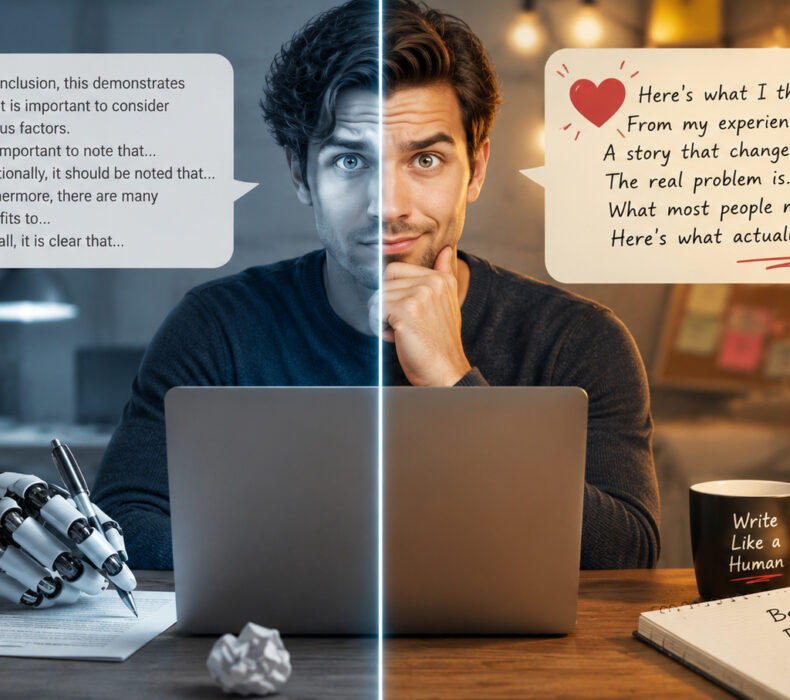
You wrote every word yourself. No ChatGPT, no copy-paste, no shortcuts. And yet your writing sounds like AI. Flat. Mechanical. Like a robot in a human costume trying to sound casual at a dinner party.
Here is the uncomfortable truth: you do not need to use AI to write like AI. You just need to write like most people do online. Same patterns. Same phrases. Same rhythm. And your writing ends up sounding exactly like the thing you were trying to avoid.
This is the honest guide to why your writing sounds like AI, and what to actually do about it.
Why Your Writing Sounds Like AI: The Real Cause
AI models are trained on a massive chunk of the internet. Corporate blogs. News articles. Academic papers. Wikipedia. The result? AI learned to write like the average of all of it.
That average sounds like this: medium-length sentences, neutral tone, formal transitions, zero personality. Technically correct. Completely forgettable.
The problem is that most people also learned to write from the internet. Same sources. Same patterns. Same habits. So when you sit down and try to sound “professional,” you produce the same average. Which is exactly what AI does.
You are not using AI. You are writing like AI. There is a difference, and it matters.
The 5 Patterns That Make Your Writing Sound Like AI
Pattern 1: Every Sentence Is the Same Length
Read this out loud: “Writing is important. Good writing takes practice. Clear writing builds trust. Readers appreciate clarity.”
Technically fine. Practically unbearable. It sounds like a metronome, not a person.
Human writing has rhythm. Short sentences for punch. Longer ones when you need to build something, explain a nuance, or let an idea breathe before you land the point. Then short again. AI writing stays in the comfortable middle, around 15 to 25 words per sentence, paragraph after paragraph, with the consistency of a tax form.
If every sentence in your piece is roughly the same length, that is your first problem.
Pattern 2: Transition Words Used Like a Checklist
“Furthermore.” “Moreover.” “Additionally.” “It is important to note that.”
These are not transitions. They are the writing equivalent of clearing your throat before every sentence. They signal that you are about to say something, instead of just saying it.
Real writers connect ideas through logic and flow, not through formal connectors borrowed from 1997 term papers. If you need “Furthermore” to hold your paragraph together, the paragraph is not holding together.
Cut them. If the sentences still make sense without the connector, the word was not helping.
Pattern 3: Vague Claims That Cannot Be Wrong Because They Say Nothing
“Many people struggle with this.” “Research shows that.” “Studies suggest.”
Which people? What research? Which studies?
Vague claims feel safe. They cannot be wrong if they are not specific. But readers feel the absence of specificity immediately, even when they cannot name it. It registers as the writing equivalent of a politician answering a question they were not asked.
Concrete details fix this faster than anything else. Not “many writers struggle with engagement” but “every writer I know struggled with this for the first two years, and most of them still do.” One sentence. Completely different weight.
Pattern 4: No Opinion Anywhere in the Document
AI is trained to be balanced. Neutral. Inoffensive. It presents both sides, hedges its claims, and avoids controversy with the discipline of a diplomat at a hostage negotiation.
That is a reasonable strategy for a language model. It is a terrible strategy for a writer.
Readers do not follow writers who agree with everyone. They follow writers who have a clear point of view, even when that point of view is wrong. In most memorable writing, opinion is not optional. It is the reason anyone reads a byline instead of a Wikipedia article.
If your piece could have been written by anyone, it was written by no one.
Pattern 5: Polished Into Oblivion
Clean. Inoffensive. No rough edges. No personality. No opinions that might upset someone. You have sanded down everything interesting until the piece is smooth and completely featureless.
Real writing has edges. A sentence that does not quite fit the tone but works anyway. A blunt observation that could have been softened but was not. A paragraph that ends early because that is where the thought ended.
Those imperfections are not mistakes. They are the fingerprints that prove a person wrote it.
My Take
The best diagnostic is also the simplest: read your draft out loud. If you can predict every word before you say it, your reader can too. That predictability is what makes writing sound like AI, whether a machine wrote it or not.
Most people fix surface-level problems. They change a word here, add a comma there. The real problem is structural. Same sentence length throughout. No position taken. No specific detail that could not have come from a Google search. Fix those three things and the writing sounds human again.
Tools like Grammarly and ProWritingAid are excellent at fixing grammar and mechanics. They are much better at fixing mechanics than fixing voice. They will not tell you that your piece has no point of view. They will not flag that every paragraph sounds the same. That part is still your job.
The Fixes That Actually Work
Vary sentence length on purpose. Write a long sentence that builds toward something. Follow it with a short one. Done.
Cut every transition word and see what breaks. If nothing breaks, the word was not helping. If the paragraph collapses, rewrite it so the logic holds without the connector.
Replace every vague claim with a specific one. “Many designers do this” becomes “every designer I know did this for the first two years, and most of them still do.” One sentence. Completely different weight.
Take one clear position per section. Not a hedge. Not “some people believe.” A position. “This approach does not work.” Full stop.
Read it out loud before publishing. Your ear catches what your eye misses. If you hesitate on a sentence, it needs work. If you sound bored reading it, your reader will be bored too.
For the grammar and mechanics side of things, we covered which tool actually handles that job better in Grammarly vs ProWritingAid: Stop Paying for the Wrong One. And if you want to see how AI writing tools fit into a broader workflow, the best AI writing tools roundup covers the full picture.
The tools handle the mechanics. You handle the voice. No tool can write like you. Which, as it turns out, is the only thing worth writing like.

Survived 20 years of clients, deadlines, and bad briefs. Started Wizformer to see if working for yourself is actually better. Jury's still out.