
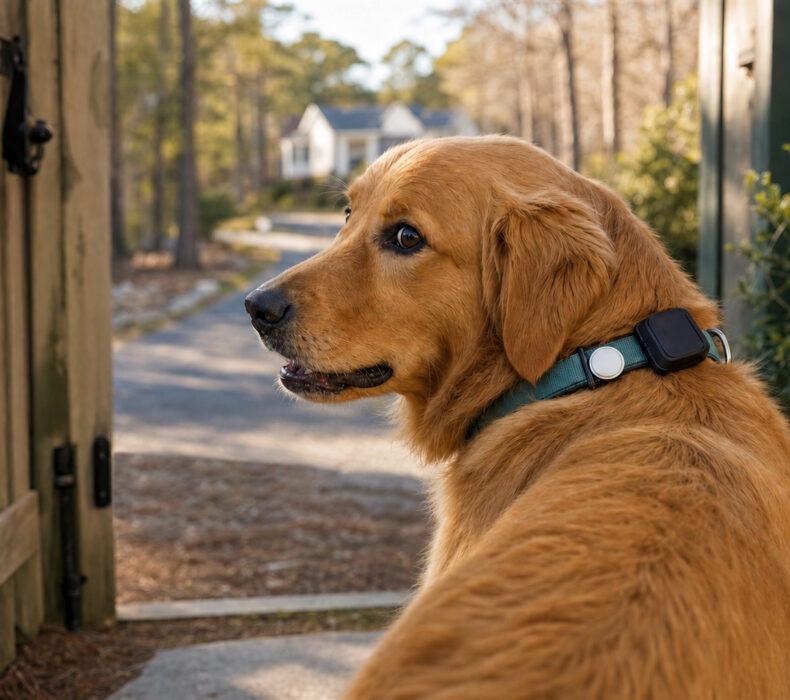
The AirTag vs GPS dog tracker debate usually starts the same way: your dog bolted once, your stomach dropped, and now you are staring at a small Apple disc that costs about as much as a pizza, wondering if it solves the problem. Here is the short version. An AirTag tells you where your dog was the last time a nearby Apple device detected it. A GPS tracker is built to tell you where your dog is now. Was versus is. That one word decides everything else in this comparison, including how well you sleep the night someone leaves the gate open. Most of the AirTag vs GPS dog tracker confusion disappears once you see how each one actually finds a dog.
How an AirTag Actually Finds Your Dog
Apple designed the AirTag for keys, backpacks, and luggage. Pets are not on that list, and that is not an oversight. An AirTag has no GPS chip and no SIM card. It broadcasts a Bluetooth signal, and when any device in Apple’s Find My network detects it over Bluetooth, that device quietly relays the AirTag’s location to you. The system is clever, anonymous, and encrypted. It is also entirely dependent on other people’s gadgets walking past your dog.
In a dense city, that can work surprisingly well. The more compatible Apple devices are nearby, the better the chance of frequent location updates. On a hiking trail, in a field, or in a quiet suburb at 3 a.m., the Find My network may go a long time without detecting the AirTag. Jonathan Bensamoun, the founder of the Fi dog collar company, put it bluntly in a Yahoo Tech interview: in a park, on a trail, or in a rural area, an update could take hours, or never come at all. He is selling the competing product, sure. He is also technically correct, and Apple’s own description of the Find My network backs the mechanics.
The AirTag’s strengths are real, though. The battery lasts more than a year and costs a few dollars to replace. It is rated IP67, so rain and puddles will not kill it. The newer generation got a louder speaker and longer Precision Finding range. Those improvements help once you are close enough to search directly. They do not turn the AirTag into a live GPS tracker. And there is no subscription. You pay roughly thirty dollars once, and you are done.
How a GPS Dog Tracker Works
A GPS dog tracker is closer to a phone than to a keychain gadget. Tractive, one of the most visible names in this space, states it plainly: the tracker has a built-in SIM card that uses mobile networks to send you location info. That means live tracking on a map, position updates every few seconds when you need them, virtual fences that alert you the moment your dog leaves the yard, and tracking that works whether or not anyone else is standing nearby. Some premium models have pushed further. Fi Ultra combines extended LTE coverage with satellite coverage through T-Satellite with Starlink. Even Fi warns that it is designed for off-leash use, not fully off-grid tracking: without cellular service, the app may not communicate with the tracker in real time.
The trade-offs mirror the strengths. Batteries last days or weeks, not a year, because live radios are hungry. Tractive claims up to two weeks for its standard dog tracker, and up to six for the XL version. And the mobile network costs money. Tractive requires a subscription for the tracker to work, and Fi locks GPS location behind its membership. Most app-based GPS trackers work this way because they use cellular networks to send the location to your phone. Radio-based GPS systems can avoid monthly cellular fees by sending the position directly to a handheld receiver, but they trade app convenience and broad coverage for expensive hardware and limited radio range. There is no free version of every advantage.
AirTag vs GPS Dog Tracker: The Difference That Actually Matters
Strip away the spec sheets and the AirTag vs GPS dog tracker question reduces to one scenario. It is 7 p.m., the gate was open, and your dog has been gone for an hour. With an AirTag, you get the last place an Apple device noticed him, which might be five minutes old or two hours old. You are reading history and hoping it is recent. With a GPS tracker, you get a dot moving across a live map, and you go get him.
To be fair to the AirTag, real GPS is not magic either. Trackers lag when cellular coverage is thin, tunnels and dense woods can blind them for a while, and a dead battery makes an expensive collar ornament. Anyone who tells you either option guarantees you will find your dog is selling something. The honest framing is probability: a GPS tracker gives you a live position most of the time, an AirTag gives you a recent position some of the time, and how often “some of the time” happens depends entirely on how many Apple devices surround your dog’s adventures.
When an AirTag Is Enough
If you live in a dense urban area, your dog is walked on a leash, and the realistic worst case is a slipped collar two blocks from home, an AirTag is a reasonable budget choice. A neighborhood full of compatible Apple devices gives the AirTag a better chance of refreshing its location quickly. This is the one setting where the AirTag vs GPS dog tracker math tilts toward Apple. The same logic makes it a solid backup: it weighs nothing, never needs charging, and sits on the collar quietly while your main tracker does the work.
One thing an AirTag does not replace is a microchip, and neither does a GPS tracker. A microchip is an ID card, not a locator. It tells a vet or a shelter who your dog belongs to after someone brings him in. It tells you nothing about where he is. The chip, the tag, and the tracker solve three different problems, and only one of them involves you finding him yourself.
When Your Dog Needs Real GPS
Some dogs are escape artists by temperament. Huskies treat fences as suggestions, scent hounds follow their nose into the next county, and dogs with separation anxiety may make frantic escape attempts around doors or windows when left alone. If any of that sounds familiar, the question is not whether a live map is worth it. It is how fast you can get one on his collar.
The same goes for geography. Rural properties, off-leash hikes, hunting trips, and camping are exactly where the Find My network can become unreliable. If your dog goes missing where people and compatible devices are rare, an AirTag becomes a message in a bottle. A cellular GPS tracker is closer to a phone call where coverage exists. Radio-based and newer satellite-assisted trackers offer other options, but each comes with its own range and connection limits. If you are choosing a specific model, our roundup of the best GPS dog trackers breaks down which ones are worth the money and which ones just look rugged in the product photos.
What It Costs
Cost is where the AirTag vs GPS dog tracker gap is widest. The AirTag costs approximately 29 dollars, plus a few dollars for a collar holder, and the battery swap once a year is pocket change. No subscription, ever. Check current pricing, but this math has been stable for years.
A GPS tracker splits the bill. The device itself is often cheap, approximately 79 dollars for Tractive’s standard model at the time of writing, but the subscription is where the real cost lives, starting at approximately five dollars a month on longer plans and more on flexible ones. Fi’s membership pricing works the same way. Over two years, expect a GPS setup to cost several times what an AirTag does. Check current pricing on the official sites before you decide, because plans and promotions shift constantly.
Whether that difference matters depends on what you are pricing. Compared to an AirTag, a GPS subscription looks expensive. Compared to one night of searching a forest with a flashlight, it does not.
When Using Both Trackers Makes Sense
For some owners of escape-prone dogs, the answer to AirTag vs GPS dog tracker is not either-or. It is both. The GPS tracker is the primary: live map, escape alerts, peace of mind. The AirTag is the dead-battery insurance that never needs charging and costs almost nothing to add. If the tracker dies on day twelve of its two-week battery claim, the backup is already on the collar.
And if you mostly worry about what your dog does while you are gone, that is a different problem than finding him. A pet camera shows you the chaos; it will not tell you where the chaos went. Watching is not finding.
Can an AirTag track my dog in real time?
No. An AirTag has no GPS and no cellular connection. Its location updates only when a device in Apple’s Find My network detects it within Bluetooth range. In busy areas that can feel close to real time. In empty areas it can mean hours-old information, or none.
Do GPS dog trackers work without a subscription?
Cellular GPS trackers usually do not. Tractive and current Fi models need paid plans because they use mobile networks to send location data to an app. True subscription-free GPS systems exist, but they typically send the dog’s position directly to a dedicated handheld receiver over radio, trading the monthly bill for higher upfront cost and limited radio range. The subscription is not a markup. It is the tracker’s phone bill.
Is a microchip enough for a lost dog?
A microchip is identification, not tracking. It works only after someone finds your dog and takes him to a vet or shelter with a scanner. Keep the chip, but do not confuse it with a locator.
AirTag vs GPS Dog Tracker: The Bottom Line
The AirTag vs GPS dog tracker choice is really one question: when your dog goes missing, do you want a history lesson or a live map? In a crowded city, that history can stay fresh enough to help. In sparsely populated areas, it may age quickly, exactly when you need it most. Use an AirTag as an inexpensive backup where the Find My network is dense. Choose a GPS tracker when frequent live updates and escape alerts justify the subscription. Your dog does not care about ecosystems, spec sheets, or the AirTag vs GPS dog tracker debate. He just runs. The only spec that matters is whether you know where.

Survived 20 years of clients, deadlines, and bad briefs. Started Wizformer to see if working for yourself is actually better. Jury's still out.