
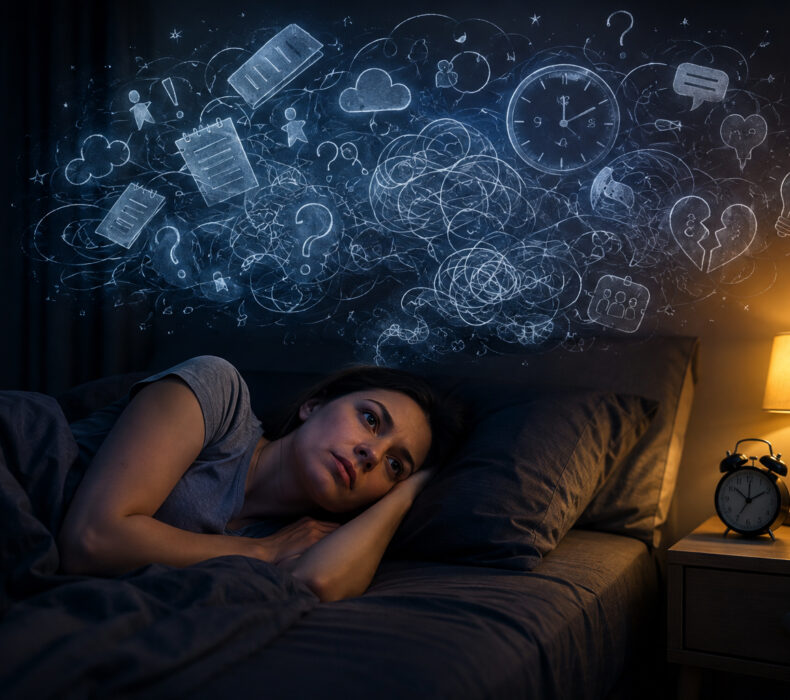
Somewhere around 3 AM, half the internet is quietly typing the same question: why is my anxiety worse at night? The house is dark. Nothing is actually happening. And yet your heart is pounding like you just ran a red light in front of a police station. If that scene feels familiar, you are not broken, dramatic, or losing your mind. You are dealing with a pattern many people know by heart – and it has reasons.
The Short Answer
Anxiety often feels stronger at night because everything that keeps it quiet during the day disappears after dark. Distraction is gone, your brain is tired, and there is nothing left to do except listen to your own thoughts. What makes anxiety worse at night is usually not new danger. It is the sudden silence around old worries. Nighttime anxiety is a widely recognized experience. Both anxiety and the sleep problems that feed it can improve with the right support, and one bad night does not erase the progress you made during the day.
That is the short version. The longer version is more interesting, and understanding it helps more than you would expect.
What Makes Anxiety Worse at Night: The Mechanics
First, some company: according to the National Institute of Mental Health, about one in five American adults experiences an anxiety disorder in a given year, and closer to one in three will at some point in life. Those numbers describe anxiety disorders in general, not 3 AM specifically – but they make one thing clear: whatever your brain does at night, it is not doing anything original. And if you notice your anxiety worse at night than at any other hour, you are describing something many people know well, not something uniquely wrong with you.
During the day, your attention is a crowded restaurant. Work, conversations, traffic, deadlines, that guy who parked across two spaces – everything competes for a table. Worry has to wait in line like everybody else. At night, the restaurant empties out. Worry gets the best table, a candle, and your undivided attention. Sleep researchers point in the same direction: with fewer external demands competing for your attention, worries that were easy to ignore in daylight can become much harder to tune out once you are in bed.
Second, your brain is tired, and fatigue can make worries harder to challenge. The mental brakes that shrugged off a worry at noon may be worn down by midnight. The same thought can land harder because the part of you that answers “we’ll handle it” has already clocked out.
Third, the quiet turns the volume up on your body. With no background noise, you suddenly hear your own heartbeat and breathing, and an anxious brain can treat every internal signal as breaking news.
And fourth, there is the learned habit – one more thing that quietly makes anxiety worse at night without you noticing. If the only time you ever sit alone with your thoughts is in bed, your brain concludes that bed is where thinking happens. It starts scheduling the day’s unfinished worry for the exact moment your head touches the pillow. Consistent, punctual, completely unwanted – anxiety runs the most reliable delivery service you never ordered.
The Toolbox Problem
Here is the part most articles skip. Many people who struggle with anxiety manage it all day by doing things. They go to work while falling apart quietly. They force themselves to meet friends. They build a table, paint a wall, clean a garage that did not need cleaning. And for many people it helps – activity, movement, and social contact are real ways to regulate stress. One honest footnote, though: constant busyness can also become a way of postponing difficult thoughts, which means the bill sometimes arrives at bedtime.
Then night comes, and most of those tools are suddenly out of reach. You cannot sand a table at 2 AM. You cannot call a friend, go to the office, or start painting a bedroom while your family sleeps. The toolbox that carried you through the day is locked, and that is precisely when the old worries show up. Not because you are weak. Because most coping tools have business hours, and anxiety does not.
If you have ever thought “I was fine all day, so why is my anxiety worse at night?” – this is why. You were not fine by accident. The day was doing part of the work for you, and night takes that structure away for a few hours.
When You Wake Up at 3 AM With Your Heart Pounding
Sometimes anxiety worse at night is something more physical: you wake suddenly from sleep with your heart racing, sweat on your back, short breath, trembling, maybe tingling running through your body. One possible explanation is a nocturnal panic attack – a sudden episode of intense fear that wakes you from sleep, which the Cleveland Clinic describes with exactly these symptoms. Nocturnal panic attacks are well recognized among people with panic disorder, although estimates of how often they occur vary considerably between studies. Symptoms often intensify quickly and then gradually subside, though falling back asleep can take a while.
Two honest notes here. One: a nocturnal panic attack can feel medically dangerous even when it is not – but nobody should self-diagnose one from an article, including this one. Two: a racing heart and night sweats can also have physical causes, including sleep-related, hormonal, and heart conditions. If you have new or severe chest pain, serious trouble breathing, fainting, or anything else that could be a medical emergency, seek urgent medical care instead of assuming anxiety is the cause. If the episodes keep coming back but are not an emergency, bring them to a healthcare professional. That is not paranoia. That is doing things in the right order.
The “All My Progress Is Gone” Feeling
The cruelest part of nighttime anxiety is usually not the racing heart. It is the story your mind tells while it races. Many people describe the same cycle: manage all day, feel human by evening, then wake at 3 AM soaked and certain that every bit of progress has evaporated. It can feel like being sent straight back to square one.
So let this be said plainly: a hard night does not mean every step forward has disappeared. Your skills did not uninstall while you slept. The day you built still happened. Anxiety is a terrible referee – it always calls the game at your worst moment, and it always lies about the score. Part of what makes anxiety worse at night is what you decide it means at 3 AM, and 3 AM is the least qualified hour of the day to judge anything. Check the score again at breakfast. It is remarkable how often the progress turns out to be exactly where you left it.
What Actually Helps
No magic here – just habits with evidence behind them, offered honestly: nothing works for everyone, and nothing works every night.
Write tomorrow down before bed. In a small study highlighted by the Sleep Foundation, people who spent a few minutes writing a detailed to-do list fell asleep faster than people who journaled about tasks they had already finished. It will not work for everyone, but one possible explanation is that putting unfinished tasks on paper reduces the need to keep rehearsing them mentally. Write the list, and the brain may finally put the clipboard down.
Give your body an off switch. Slow breathing and progressive muscle relaxation may reduce the physical revving for some people. Ten slow breaths will not fix your life, and some nights they will not even fix the next ten minutes. Other nights, they may interrupt the spiral before it builds. They cost nothing, so they earn their place in the rotation.
Do not negotiate with the mattress. If you have been awake long enough to feel frustrated, get up. Dim light, a quiet and boring activity, no doomscrolling, and back to bed when you actually feel sleepy – without checking the clock on the way. This is based on a standard CBT-I technique called stimulus control, and its whole job is to protect the one association that matters: bed means sleep, not negotiation.
Watch the afternoon coffee and the nightcap. Caffeine has a longer memory than you do. And alcohol can be a con artist – it may make you sleepy at first, then quietly disrupt your sleep later in the night.
Keep the daytime habits that carry you. The work, the friends, the table you built – that counts, and it stays. The goal is not to replace your daytime toolbox but to add a few tools that still work in the dark.
And if anxiety keeps running your nights, talk to someone trained. Cognitive behavioral therapy is an evidence-based treatment for several anxiety disorders, and a related approach called CBT-I was designed specifically for persistent insomnia – which matters, because the two problems love feeding each other. Therapy is the kind of tool that does not care what time it is – the skills stay with you long after the session ends. It is not an overnight fix, and it does not need to be.
If getting to an office is a barrier – or if 3 AM is exactly when you wish help existed – Online-Therapy.com offers a CBT-based program you can work through from home, on your own schedule. You can take the free assessment and see where you stand. No waiting room, and nobody asks why you are awake.
We have also written an honest look at whether online therapy is worth it if you want the full picture first. And if your nights are more exhaustion than fear, our guide on why you can’t sleep even when you’re exhausted picks up where this article stops.
FAQ
Why is anxiety worse at night even after a good day?
Because a good day is often a structured, busy day – and structure is a painkiller with a time limit. When the demands and distractions of the day go offline, the worry your brain postponed finally gets an audience. A rough night after a good day is not a contradiction. It is a schedule.
Why does my heart race when I wake up at night?
A nocturnal panic attack is one possible cause, but a racing heart at night can also have sleep-related, hormonal, heart-related, or medication-related explanations. If it is new, frequent, or comes with chest pain or serious trouble breathing, treat it as a medical question first and have a healthcare professional evaluate possible physical causes.
When should I get help for nighttime anxiety?
When it is regular, when you start dreading bedtime, or when next-day exhaustion is shaping your life. If anxiety worse at night is a steady part of your week, that is reason enough – you do not need to earn help by suffering a minimum number of months first. And anything that looks like a medical emergency is a different door: urgent care now, explanations later.
The Part Worth Remembering
They say the night is darkest before dawn, and people repeat it like the darkness is what brings the morning. It is not. Dawn shows up because the clock keeps moving – and your clock keeps moving too, even at 3 AM, even mid-spiral, even on the nights that feel like square one. The person lying awake is not the truest version of you. It is just the version that happens to be on shift when the lights are off. Morning knows better. Never let 3 AM vote on tomorrow.
This article is for information and education only. It is not medical advice, it cannot diagnose anything, and it is not a substitute for a professional who knows your situation. If symptoms are new, severe, or could indicate a medical emergency, seek urgent medical care. If anxiety is making your life smaller, a mental health professional is the right next step.

Survived 20 years of clients, deadlines, and bad briefs. Started Wizformer to see if working for yourself is actually better. Jury's still out.